
Pump Head, Flow and Water Power Measurement
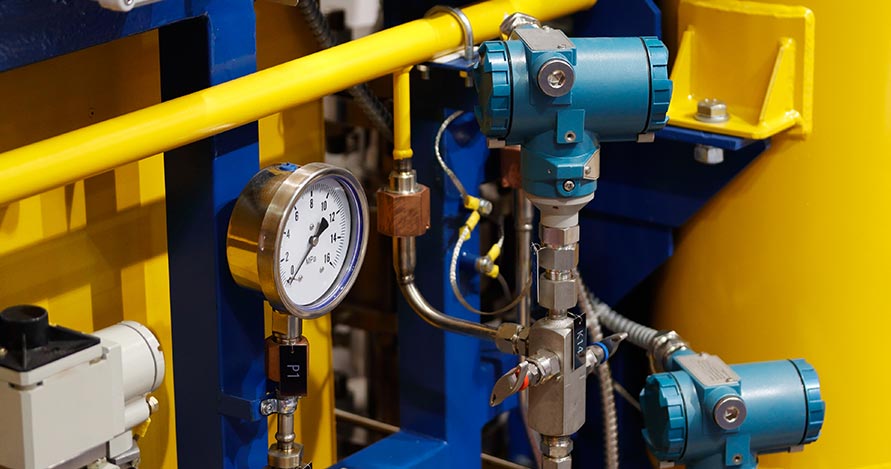
Pair a Himmelstein transducer with the Model 721+ Mechanical Power Instrument and the right pressure transducers and flow meters, and you have a complete pump performance station. The 721+ displays pump head in PSI on Channel 1, flow in GPM on Channel 2, and water horsepower on Channel 3. Any channel can be brought up from the front panel, max/min data can be recalled on demand, and limits can be set per channel. Limits download from a host computer and test data uploads back to it: straightforward integration with the data acquisition system you already use.
Compressor Ripple Torque, Running Torque and Speed Tester
The Model 721+ also serves as a Compressor Ripple Torque, Running Torque and Speed Tester for single-phase motor and compressor combinations. Excessive ripple causes noise and vibration that shortens compressor life, while running torque and speed verify the assembly is hitting its efficiency targets. The instrument measures torque on Channels 1 and 3 and speed on Channel 2. Once the assembly reaches minimum acceptable running speed (detected by the Channel 2 low limit), Channel 1 automatically switches to Do Max/Min mode and classifies torque ripple. At final speed, Channel 2 classifies running speed and Channel 3 classifies running torque. A Good/Bad signal is generated for every unit and is usable directly at end-of-line stations.
Relevant Applications of Torque Sensors for Compressors
Himmelstein torque sensors for compressors and pumps are specified across heavy industry wherever efficiency, reliability, or compliance data has to be defended. Common applications include:
- Pumps and pump stations in power plants
- Pumps in the petrochemical industry
- Processing pumps in the food and beverage industry
- Processing compressors in oil and gas, mining, and bulk handling
- Pipeline compressors in the natural gas industry
- Feedwater pumps in steam boilers
Why Choose S. Himmelstein for Pump and Compressor Testing
Himmelstein has been building torque measurement instruments in the United States since 1960. Every transducer is designed, machined, assembled, and calibrated at our Hoffman Estates, Illinois, facility, so the people answering your support call are the same ones who built your sensor. Here's what that gets you on a pump or compressor test stand:
- Real-world accuracy, not just calibration-stand accuracy.Our transducers maintain their published specs under the side loads, vibration, and temperature swings of an actual test cell.
- ISO/IEC 17025:2017 accredited calibration. Every unit ships with NIST-traceable calibration documentation from our accredited metrology laboratory (NVLAP Lab Code 200487-0), and we calibrate other manufacturers' transducers as well.
- Wider useful range per sensor. High-accuracy Bearingless Digital Torquemeters cover broader horsepower spans, reducing sensor changeovers and keeping you within Hydraulic Institute uncertainty limits.
- Built to last in production.Our customer base includes Caterpillar, Ford, Lockheed, Exxon, Bell, and Rockwell. These companies demand instruments that hold up through years of duty cycles.
- In-house engineering support. Need a custom range, fitting, or signal output? Talk to the engineers who designed the product.